This is so exciting! I’ve been accused of violating Federal law, and I feel like an international fugitive. Jason Bourne, here I come!
Have you ever heard of the Digital Millenium Copyright Act? I had, but I assumed that it was related to copying movies and downloading music and such.
Last Thursday, I received an email with the following subject line: “Blogger blog takedown notification”. With that odd wording, I initially thought it was a phishing attempt, but I ventured to open it anyway. Blogger wouldn’t really take down my blog, would they? Turns out it was sort of, but not quite, what it said: a notification from Blogger that they had taken down one of my posts. The email stated that they’d been notified that “certain content in your blog is alleged to infringe upon the copyrights of others,” and indicated the specific post in question.
The email offered a website where I could go to find the actual complaint, but as of today, more than a week after the email, this particular complaint still has not shown up on the site. Fortunately, the post in question – December 9, 2011 – only contained one photo, so it was easy to figure out where the complaint came from. I’d posted a picture of a German bread, with a prominent link to the source. You can go here to see the post if you are interested. I don’t think anyone much cares what I said 3 months ago, but for the sake of continuity I deleted the image and republished the post.
I went back to the source to look for use restrictions, and realized that the site is in German. Aha! I would not have gone to all the effort of trying to read the whole thing just for a simple photo. My mistake. After translating and paging through the volumes of legal language, I now understand that this particular site does not allow ANY use of their images under ANY circumstances EVER. “Not even for a fee,” it says!
So, I think this means I not only violated a US law, but possibly some German or EU law as well. This gets better and better! The CIA is probably vying with Interpol to get my phones tapped, right now.
But going back to the email from Blogger (really Google): why did they take the liberty of reverting my post to Draft status, rather than waiting for me to respond to the notification? Because the DMCA allows online service providers to attain “safe harbor” from litigation by blocking access to or removing the material in question. I can understand Google’s position – if the copyright owner were to sue for infringement, would they be more likely to sue me, a penniless individual, or Google with its deep pockets?
DMCA is one of those laws that seems great at first glance. On the positive side, if I posted original art or writing on my blog, and someone copied it and used it without crediting me, I would very much like to file a complaint against them and make them stop. The artists and designers whose blogs I read frequently mention that others have stolen their work or made unauthorized use of it, and I support them in trying to prevent that. In the future, I will not simply assume that images are just sitting there waiting for me to use as I wish, Instead, I'll review the terms of use on each site.
On the negative side of DMCA, however, there are no police, judge, or jury over this process of complaint and takedown. Anyone can file an infringement claim against any individual or company, and force them to either remove the content or go through miles of red tape to file a counter-claim. This creates the potential for people to file nuisance claims, and it’s likely that this is already happening. This could have a significant negative impact on individuals and small businesses.
My explanation here is short and oversimplified, but what are your thoughts on having Google or other service providers removing content from people’s blogs? Have you received any violation notices, and if so, how did you respond?
Katrina
Friday, March 9, 2012

Wednesday, March 7, 2012
Pants Patterns Part 1
My first step on the pants project was to learn how to adjust a standard sewing pattern to fit a non-standard body. I am fairly familiar with the idiosyncrasies of my figure, and didn’t need help to realize that I have a protruding belly and a flat butt. But I definitely needed help translating that to fit. Simply measuring the pattern and comparing it to my own measurements just told me that a garment in my size would cover the proper areas. It did not tell me whether the front would pull, the back would droop, or the inseam would twist around my legs.

This is where the fitting guides come in handy. There is an abundance of fitting guidance out there, in books, videos, websites, and classes, and it’s easy to be overwhelmed by the information. I tried to limit myself to two main sources, which I chose simply because they were the first two that seemed to offer a comprehensive approach to all possible adjustments.
One source was the Collette Patterns Pants Fitting Cheatsheet, which you may be familiar with. It is a long list of pant-fitting symptoms, the associated body shape, and the necessary adjustment. It’s extremely helpful in narrowing down the cause of odd wrinkles, bagginess, and crooked lines. Each adjustment is illustrated with a diagram. The only thing missing from this checklist is photos of the fit problems, which would be helpful in the case of something like “excess fabric pooling under butt”, which could be due to a swayfront, a low butt, or a flat butt.
My other source was a book I picked up at Goodwill some time ago: Sewing Pants That Fit, from the Singer Sewing Reference Library.
 Still available
I like this book because it has a big color photo of pants with each different fit problem, and the corrective pattern adjustment on the page right next to it. The directions are very simple and listed step by step. My one reservation about the book is it’s a 1989 edition, and the high-waist, pleat-front pant that is used to illustrate the majority of the book is not applicable to today’s styles.
Between Collette and Singer, I gathered that for the full belly, I would want to slash the pant front horizontally approximately 3 inches down from the waist. Then the slash is split apart to create a wedge and the seamline is redrawn.
 This is a simple straight cut according to Singer, while Colleterie suggests a three-part slash and spread (see below).
I used the Singer approach on the narrow-leg pants muslin, adding a small wedge to cover the belly fullness.
 This seemed to work, although I also ended up adding front darts to the pattern to take up a bit more of the waist-to-belly difference.
On the wide-leg pants, it occurred to me that instead of wedging the waist up, I could try bumping the center front out.
 Doesn’t the Collette procedure look as though it has the same result as drawing a curve around the belly?
 This may not be the correct thing to do, maybe something to do with grainline at center front, but it made sense at the time.
 I drew the round belly shape on the new pattern, and sewed around it just like the rounded seams at the hip. The muslin pant front seems to fit fine.
Now, I need to do a bit of experimenting with the “flat seat” adjustment. My first muslins did not have any adjustment in the back, and they fit okay, at least initially. With ready-to-wear pants, I find that they fit well when I put them on and then after several hours of sitting the seat stretches out and bags down at the tops of my thighs. I don’t know whether this is a fit problem, or I just have too many pants made from weak, non-recovering fabric. I do think I will try at least two types of seat adjustment, and compare the results.
A couple of things I found that really helped the fitting:
• I inserted real zippers, rather than just pinning the seam closed for fitting.
• I sewed on the waistband to stabilize the top edges of darts and seams.
• I wore bike shorts when fitting the muslins on myself. This helped to prevent additional bulges that are created by underwear elastic.
After I get an acceptable fit in the muslin, I’ll try both patterns in inexpensive pant-weight fabrics, to double check that the fit still works.
Onward!
Katrina
Monday, March 5, 2012
Garden Goodness
March is gardening month here, and it’s usually the last time we Phoenicians can comfortably work outside until late October. So, although I’ve committed to muslining (is it a word?) my pants patterns, I also should get a few outdoor tasks done while I can.
I’m already late for the winter-to-summer vegetable garden transition. Most summer vegetables need to be seeded before the end of February so they have time to mature and set fruit before the over-100 degree heat arrives in May. Tomatoes in particular will flower profusely in the heat but not set a single fruit.
I’m already late for the winter-to-summer vegetable garden transition. Most summer vegetables need to be seeded before the end of February so they have time to mature and set fruit before the over-100 degree heat arrives in May. Tomatoes in particular will flower profusely in the heat but not set a single fruit.

last year's tomatoes, right before summer
Fortunately, I’ve decided to omit the tomatoes from the garden menu this year, and do a little crop rotation with peppers and squash.

a great seed company with all desert-adapted varieties
I’ll put the squash seeds into last year’s tomato beds, and plant the peppers where I’ve just pulled the winter beans and peas out.

these pepper varieties have grown for me in the past
There are some survivors from the winter garden. I am still coaxing a few leaves of lettuce, harvesting loads of parsley, and trying to keep the cilantro shaded to postpone the inevitable bolt. And, the carrots are coming on strong! If any of you have tried growing carrots, you probably know that patience is absolutely crucial. Even though the seed packets usually estimate 60 days to harvest, I find it is more than twice that.

These were harvested at 140 days!
Wish me luck with the vegetables, although we are at the mercy of the weather, so... wish me luck with the weather!
Katrina
Friday, March 2, 2012
March is My Muslin Month
Thank you all for the wonderful ideas and encouragement on my craft overload situation. While I ponder the pros and cons of selling, donating, and storing stuff, I'm back in sewing mode. I’ve decided that instead of launching into another flurry of production, I will slow down for a month and do some prep work for more complicated projects. Specifically, fitting pants. (For those of you in the UK, that would be trousers!) I really lucked out with my taupe seamed pants from V2691 , which required only minor adjustments which I was able to accomplish easily because of the extra seams. I don’t expect things to go that smoothly with other patterns, because I’m not an exact size, and my bulges are not in the same places as the pattern models’.
So, it’s a month of muslins for me. I should be able to get three or four patterns fitted, and I will be good and sick of the whole process by the end of it.
There are four styles for which I’d like to nail down a pattern and get it fitted so I can go back to it repeatedly. My first challenge will be choosing among the many options.
Simple, flat-front, wide-leg pant:

 It's a bit hard to see on these wardrobe patterns, but the pants are fitted at waist and draping with a slight flare from the hips to the floor. This is my usual pant style.
Narrow-leg pattern that can be used for capri or cigarette pant: 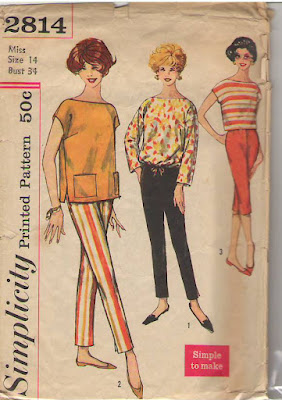
 The shape looks the same in 1959 and 2011! Not as flattering on me, but the narrow leg looks better under tunics and oversized tops than a wide leg.
Funky, non-traditional jeans:

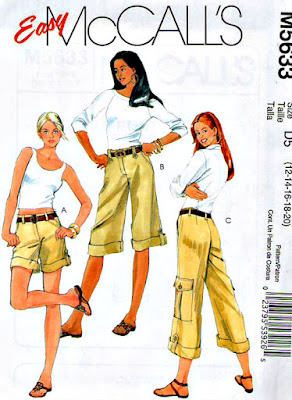
Skinny leg, baggy, flared, bootcut, mom jeans, low waist, hi-rise, stonewashed, faded, dark rinse, colored. So many choices out there! I just want a comfy denim pant that isn’t too tight but looks nice. A couple of fun details and topstitching are good, but I’m not getting into rivets or back pockets.
Try out the high-waist style

I love the look, but will it work on me? I have the sense that the front would have to be boned to keep my so-called waist from flopping over and squashing the fabric into a puddle in my lap. Good reason to do a muslin first.
I'm off to Pattern Review now, to see what other users had to say about some of the patterns.
What's on your list for March?
Katrina
Subscribe to:
Posts (Atom)