Pages

Monday, January 14, 2013

Piemaker's Day Off

For the first time ever, the Piemaker declined to make a pie. Actually it was worse than that: he said I had a choice – he could spend Saturday taking down broken tree branches and clearing the yard, or he could make a pie. Well! I never! I chose the tree branches, and it serves him right, I say.

To recover from the shock of it all, I made a pie.  This is the Raspberry-Marzipan Tart from December’s Martha Stewart Living.
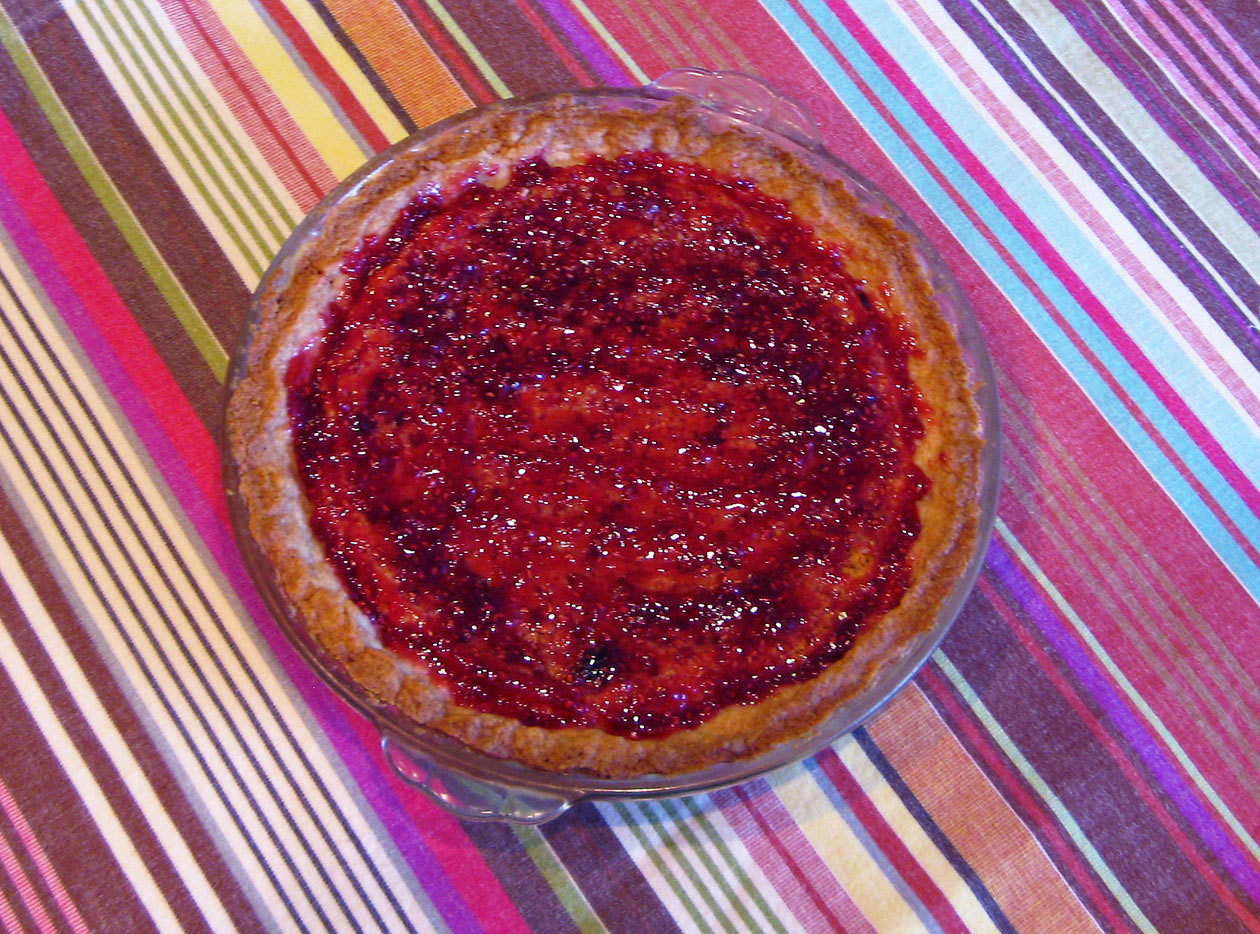
Usually the MSL recipes have too many complex steps and require too many expensive ingredients for me to have much interest in them, but this one had a short list of ingredients and was quick to put together.

I’m describing it as an inside-out Linzer Torte, because the layers of raspberry and almond are reversed. Linzer Torte usually has layers of fruit preserves between almond pastry crust.
The Raspberry-Marzipan Tart has a ground almond filling between two layers of preserves. The only major change I made to the published recipe was to double the amount of almond extract.
The tart is delicious! I think this crust and the almond filling would also be good with other fruit preserves and, of course, chocolate.

Yes, the Piemaker got to eat some of the pie after he spent all day working in the yard.

What’s cooking and baking in your kitchen?

Katrina

Friday, January 11, 2013

Garden Update

There has been a slight improvement since I added a phosphorus supplement in the form of bonemeal to my vegetable garden. This was to offset the nitrogen overload I mentioned here.

The pod peas are giving us some nice edible pods now! Success!
 
The snap peas finally have flowers, but still no pods. These plants are now at 120 days (maturity date on the packet is 72 days).

The cauliflower plants are as leafy as ever, with lots of caterpillar holes but no sign of florets.

I was about to say the same of the broccoli, until I saw a tiny little flower starting in one of the plants. There is hope.
 
The tomato is covered with these promising fruits, which are hard as rocks. I’ve brought a few inside, but they show no sign of ripening.
 
The next challenge will be the upcoming freeze. The overnight lows are predicted to fall below freezing for at least two days, although I expect it to be four. I’ve got enough sheets to cover all the small plants, but the large citrus trees are going to have to tough it out.
The humans and beasts will all be huddling for warmth inside. We’re not used to freezing temperatures!

 
Hope you all have a nice weekend and stay warm!
Katrina

Monday, January 7, 2013

The Carnivore’s Conscience

Warning: today’s post may be disturbing to vegetarians or animal lovers.

Warning #2: today’s post may be very long.
As of Saturday, we have approximately 150 pounds of beef in our freezer. While this may seem excessive to you, imagine how shocking it is to me, a former vegetarian.

Alton Brown's beef map, source

How did we find ourselves in such strange circumstances? It was a long road. In the past few years, the Piemaker has gone from the all-American, 3-squares-a-day, meat-based type of diet to a single meal each day consisting of a huge salad. He usually eats a meat dish once a week at the most.
I’ve gone in the other direction. I have come a long way from my Diet for a Small Planet days, circa 1975, when I gave up meat forever (forever turned out to be 3 years) for political and humanitarian reasons.

Today I eat meat regularly, but I do still believe that the mass production of animals for food is one of the most cruel and unhealthy activities that humanity engages in, and that the resulting meat reflects the terrible conditions that the animals endure. I also still believe that the growing population of the world cannot be fed adequately by animal protein and that at some point, if we are to survive, humans will have subsist on plant or manufactured proteins.

That said, if one shifts from a global view to a local view, there is still the possibility for communities in some areas of the world to provide a healthy, varied diet to their populations, if they follow socially responsible food production and consumption principles. Sharing is the most obvious one of these, and is the reason for the success of community gardens throughout the ages. My best example is a simple one: here in the low desert we can grow huge amounts of citrus and some herbs in the winter, while our friends in Northern Arizona have no citrus at all, but they are overrun with tomatoes every summer. Sharing the wealth with each other and many other friends and neighbors creates ripples of benefits through a large community. Soon everyone is exchanging bundles of fruits and vegetables (and once in a while, a plate of cookies!) over fences.
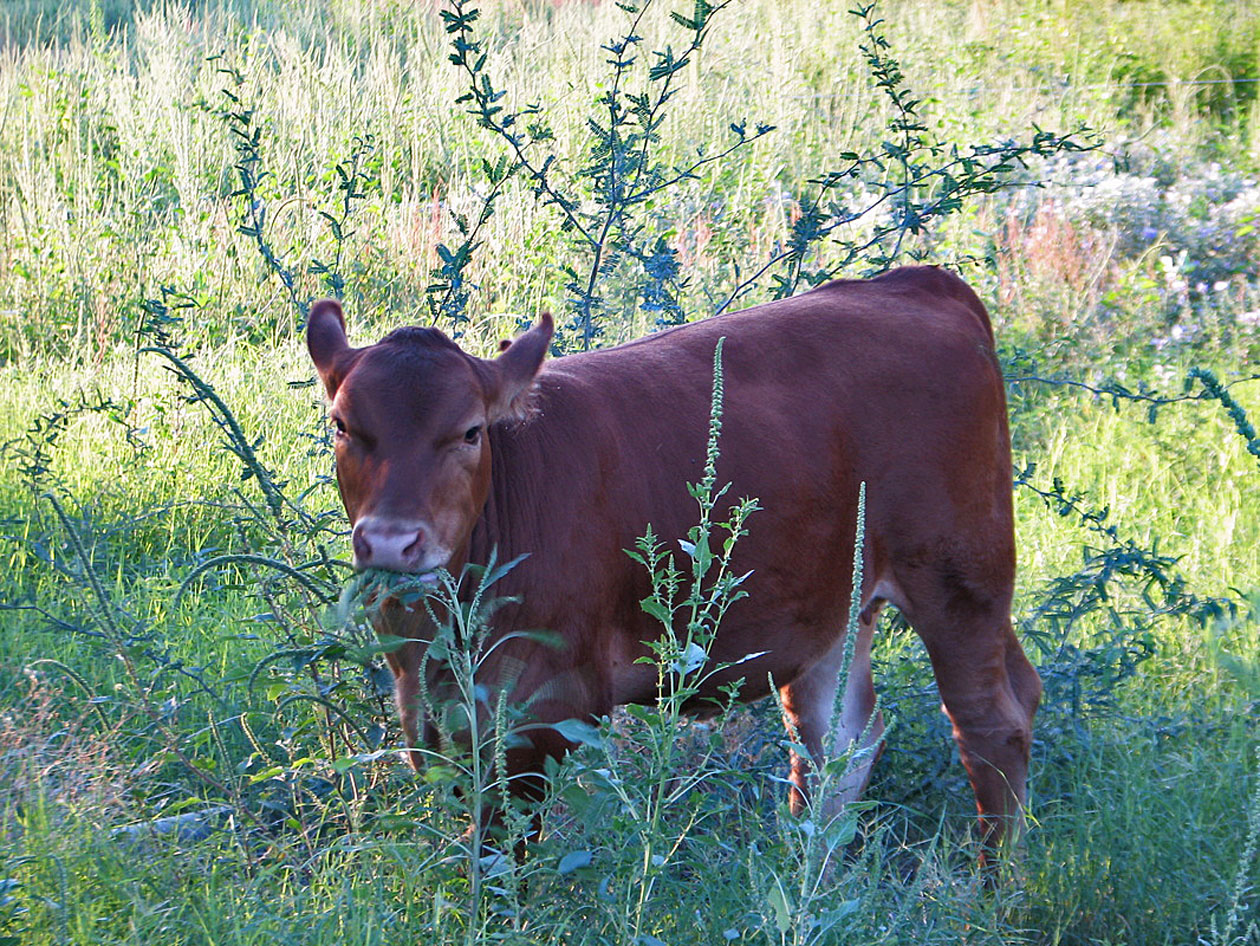
Double Check Ranch steer having a snack, source
Yes, I am going to get back to the beef eventually.


When I read The Omnivore’s Dilemma a few years ago, it just reinforced many aspects of a philosophy that had been slowly forming in the murky recesses of my mind.
My philosophy basically condenses down to one central concept: I want to know what is in my food and where it came from before I eat it.

As you may know, taking a personal interest in in your own health or that of food animals can make it difficult to eat! We all went through the days when organic vegetables were nearly impossible to find and exorbitantly expensive if available. Now it is the animal products. Cage-free eggs are getting easier to find, but they are three times the cost of regular. Grass-fed beef is available at some grocery stores, but it’s twice the price of the alternative. I think you can only get the pork equivalent direct from the rancher, unless you find a seller at a farmers market.

When I learned that our incredibly talented farming friends were raising steers, I knew it was the best way to for us to go. I visited the animals and saw them running around in the meadow, enjoying their varied grassland. I knew that they were never exposed to illness or cruelty.  The small local processor was able to kill the animals humanely (although this always sounds like an oxymoron). And, because of friends and friends-of-friends, we could all share the cost and get a large amount of food for significantly less than we would pay at the grocery store.
And so, the neatly-wrapped packages stacked in the freezer represent one quarter of a healthy animal that ate good food, got lots of exercise, and had a pleasant, if short, life. Have I made peace with eating him? I am working on it!


What experiences have you had in this brave new world of food sourcing, food scares, and so much food information?

Katrina


An afterthought: I probably should have put this above, but I didn't want to goof up the fomatting.

Here is link to a website which lists grass-fed ranches and similar operations in the US and Canada. It's exciting to see that the number of listings has almost tripled in the last couple of years.
 
[I don't know anything about these ranches, I just loved the pictures]
Lawton Family Sugar House grass-fed cattle in Massachusetts, source

Fruitland America grass-fed cattle in Missouri, source

Friday, January 4, 2013

Coming Up Roses

In order to quell my impatience over my clumsy hand (still can’t work scissors), I’ve been making plans for the gifts I wasn’t able to finish in time for Christmas. One of them was a special order: a pink rose pillow.

The pillow part is fairly straightforward, mostly a question of size and shape. But the rose aspect is so complex, so multifaceted!

http://ms1.embroideryshristi.com/3532-thickbox/beautiful-pink-rose-embroidery-design.jpg
source
Will the rose (or roses) be printed, painted, embroidered, appliqued, quilted, or three-dimensional made of fabric petals, gathered ribbons, felt, or some as yet unknown type of design?

source

I got so many ideas I had to start tracking them on Pinterest.  
 
Rose pillow
source


source


fabrics on fabric.com


So far I’ve experimented with a couple of ideas, and already learned a few lessons! (Hint: check your fabric content before embroidering, as cotton-lycra does not work well for this. LOL)
Katrina